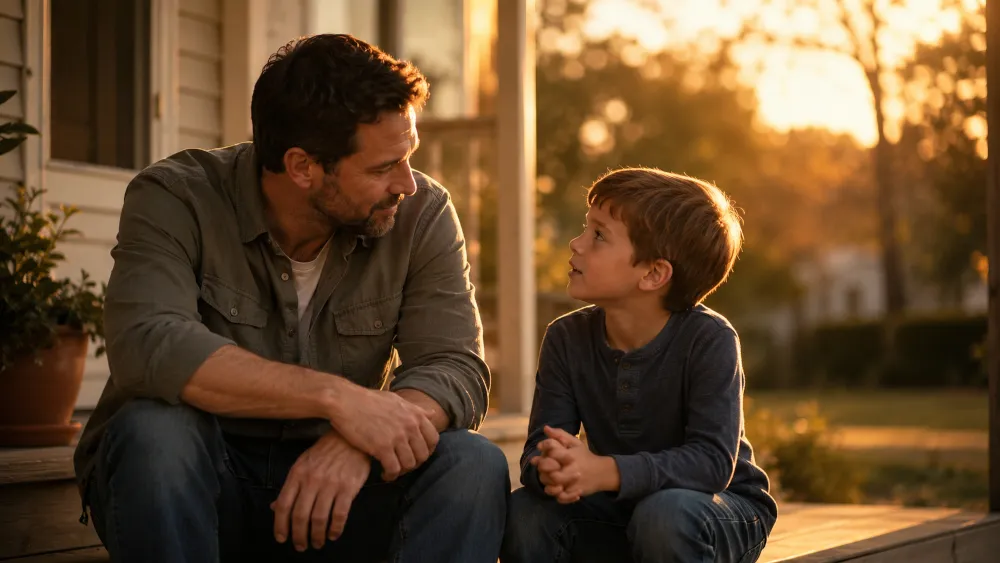
The Kind of Presence That Counts
Being a present father does not always mean having the right answer, planning the perfect moment, or knowing exactly what to say. Sometimes fatherhood is shaped by ordinary attention: listening when it would be easier to rush, repairing mistakes when patience runs thin, and showing up consistently in the small moments children may carry longer than we realize.
This chapter is about learning that presence matters more than perfection.
Fatherhood isn't measured in milestones alone.
It's measured in minutes.
In how often you choose to be there when no one is watching, when the moment won't be remembered as special, when it feels ordinary enough to be overlooked.
Those are the moments that matter most.
That lesson began in How Fatherhood Changes You, where I reflected on how fatherhood first reshaped responsibility, fear, and love.
I've learned that my children don't always need my solutions. They need my attention before they need my answers. They need me to pause what I'm doing, lower myself to their level, and listen as if what they're saying is the most important thing in the world.
Because to them, it is.
What Being Present as a Father Really Looks Like
I used to think being a good father meant providing stability, structure, and answers.
And those things matter.
But presence isn't just about provision.
It's about availability.
It's sitting through stories that wander without a point. It's answering the same question again without frustration. It's showing up to events even when life feels heavy and energy feels thin.
Sometimes presence is active.
Playing.
Teaching.
Guiding.
Helping them understand the world.
Sometimes presence is quiet.
Sitting nearby.
Listening without correcting.
Letting them know they are not alone.
Being emotionally reachable even when there is nothing urgent to solve.
Either way, they notice.
Children may not remember every instruction, every correction, or every explanation. But they remember how often they felt seen. They remember whether their voice mattered. They remember whether coming close to you felt safe.
That is why What Children Remember About Their Parents belongs close to this chapter, because ordinary presence often becomes part of a child’s emotional memory long before they can explain it.
When I Get It Wrong
There are days I'm distracted.
Days I'm tired.
Days when my patience runs out before theirs does.
I don't hide those moments from myself anymore.
Instead, I try to repair them.
I've learned that apologizing to your children doesn't weaken authority. It strengthens trust. It teaches them accountability, humility, and the truth that love doesn't disappear when mistakes are made.
Repair has become one of the quietest but most important parts of fatherhood for me.
It says:
I was wrong.
You still matter.
My frustration is not bigger than my love.
Our connection is worth coming back to.
That kind of repair does not erase every mistake, but it teaches something important. It shows children that love can be honest without being unsafe. It teaches them that strong people can apologize. It reminds them that relationship matters more than pride.
Those moments have shaped me just as much as they've shaped them.
Presence Requires Patience
Presence sounds gentle until life tests it.
It is easy to say I want to be present when everything is calm. It is harder when there is noise, interruption, exhaustion, repeated questions, unfinished work, and a child needing attention at the exact moment I feel empty.
That is where presence becomes practice.
It asks me to slow down when I want to hurry.
To listen when I want to correct.
To explain when I want to snap.
To remember that small moments can feel large to a child.
Presence is not only being physically nearby.
It is being emotionally available enough that my children do not have to wonder whether I am safe to approach.
That connects closely to How Fatherhood Teaches Patience Through Everyday Moments, because fatherhood keeps revealing that patience is not something I simply have. It is something I practice in the moments where love has the most to lose.
A Faith That Shows Up in Actions
I don't always have the right words.
But I try to model the right posture.
Faith, in fatherhood, looks like restraint. Like choosing grace over reaction. Like trusting that consistency plants seeds even when results aren't immediate.
“Let us not love with words or speech but with actions and in truth.”
It reminds me that my children will remember love less by what I claimed and more by how consistently I made them feel seen.
That verse feels less like instruction and more like confirmation.
Because love, in this role, is lived more than it is spoken.
What I Hope They Remember
I don't know what my children will remember most about these years.
I hope it isn't only the mistakes or the moments I missed.
I hope they remember that I tried.
That I showed up.
That I kept learning.
That even when life wasn't perfect, they were never invisible.
I hope they remember a father who was still becoming, but still present.
A father who did not always get it right, but cared enough to repair. A father who listened when it mattered. A father who kept choosing them in ordinary ways, even when no one else saw the effort.
This chapter—like fatherhood itself—isn't about finishing strong.
It's about staying present while the story is still unfolding.
What This Chapter Taught Me
Presence is often built in ordinary moments, not major milestones.
Children need attention, honesty, patience, and repair more than perfection.
Love becomes more trustworthy when it is shown consistently through action.
I am learning that being a present father is not about having every answer. It is about becoming someone my children can come to without fear, someone who listens before rushing, and someone willing to repair when love needs to be restored.
Presence is not perfection.
It is love made visible through consistency.
Continue the Story
- How Fatherhood Changes You
How fatherhood first reshaped responsibility, fear, and the quiet decision to keep showing up. - How Fatherhood Turns Responsibility Into Love
A reflection on how fatherhood turns responsibility into intentional care, sacrifice, and steady love. - How Fatherhood Teaches Patience Through Everyday Moments
Learning restraint, calm, and patience in the ordinary moments of parenting.
Move Through This Book