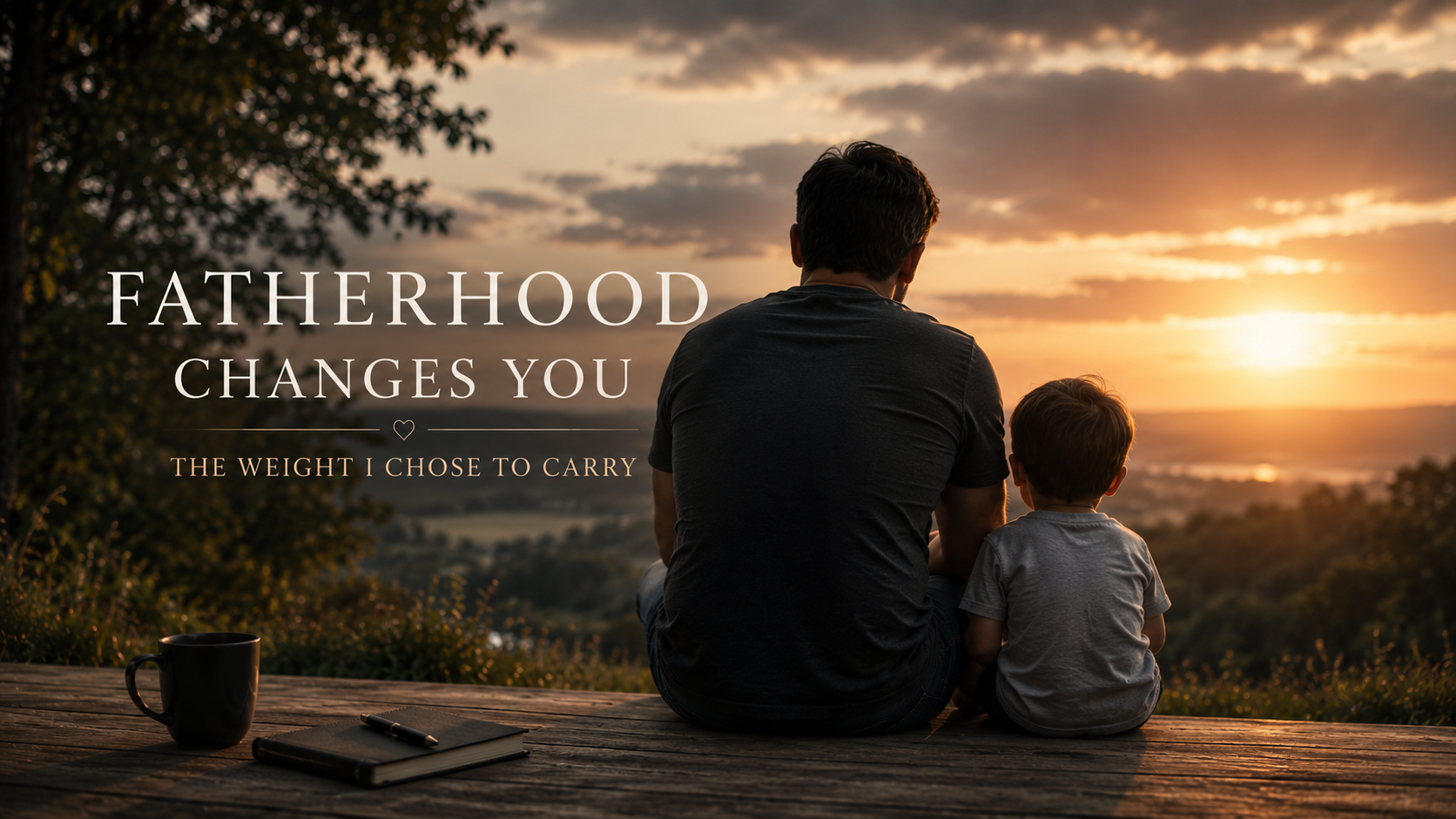
The Weight I Chose to Carry
Fatherhood can change you long before you feel ready for it. Many fathers carry quiet fears about failing, falling short, or repeating the mistakes they grew up with while still trying to show up with patience, love, and consistency every day.
This chapter reflects on learning fatherhood in real time, the weight of being needed, and the quiet growth that happens when you choose presence over perfection.
Fatherhood didn't arrive in my life with fireworks or clarity. It came quietly, the way most life-changing things do—wrapped in responsibility before I fully understood what it would cost me, or what it would give back.
I didn't become a father because I felt ready.
I became one because life trusted me with something fragile.
Something unfinished.
What I didn't realize at the time was that fatherhood would not simply add meaning to my life. It would rearrange it. Priorities shifted. Time became sacred. Failure felt heavier, but love became louder.
How Fatherhood Changes Your Priorities
Fatherhood changed what felt urgent.
Before children, time felt more like something I owned. After children, it became something I was responsible for stewarding. My choices no longer affected only me. My schedule, my patience, my habits, my work, my reactions—they all began shaping more than my own future.
That shift is difficult to explain until you live it.
You begin to understand that love is not only what you feel. It is what you rearrange. It is what you make room for. It is what you protect when life gets crowded.
Fatherhood taught me that priorities are not proven by what I say matters.
They are proven by what receives my presence.
That lesson also connects to What Children Remember About Their Parents, because children often carry the ordinary patterns of presence longer than we realize.
The Responsibility No One Sees
A lot of fatherhood happens where no one applauds.
It happens in the decisions that never become stories. The tired mornings. The late nights. The quiet adjustments. The moments when you choose patience even though you are exhausted, or choose presence even though part of you wants to disappear into your own thoughts for a while.
Responsibility does not always feel inspiring while you are carrying it.
Sometimes it feels heavy.
Sometimes it feels repetitive.
Sometimes it feels like doing the right thing without anyone noticing how much it costs.
But fatherhood has taught me that love is often built in the unseen places. It is built when I keep showing up after a hard day. When I listen instead of rushing. When I repair after falling short. When I choose to be steady even when I do not feel strong.
That is why responsibility looks different when it’s love. It stops being only a burden and becomes something sacred—something chosen, repeated, and shaped by the people depending on you.
Learning Fatherhood as I Go
There's a myth that fathers are supposed to know what they're doing. That confidence comes with the title. The truth is far less polished.
I've learned most of what I know by getting it wrong first.
I've learned that being present matters more than being perfect. That consistency outlasts grand gestures. That children don't need heroes. They need safety, honesty, and someone who keeps showing up, even when tired, frustrated, or unsure.
That is part of How to Be a More Present Father, where presence becomes less about grand gestures and more about consistency, attention, and repair.
Some days, fatherhood feels like strength. Other days, it feels like restraint—choosing patience when instinct says react, choosing calm when the world already feels loud enough.
I am still learning that.
I am still learning how to pause before I speak. How to lower my voice when frustration rises. How to remember that correction without connection can leave a mark I never intended to make.
Fatherhood keeps teaching me that love is not only shown in what I provide.
It is shown in how safe I become.
How Fatherhood Reveals What Still Needs Healing
One of the hardest parts of fatherhood is realizing that children do not only reveal your love.
They also reveal your unfinished places.
They reveal impatience you thought you had outgrown.
They reveal fear you did not know was still driving you.
They reveal the tone you use under pressure.
They reveal whether your peace is real or only present when life is easy.
That kind of mirror can be uncomfortable.
But it can also become grace.
Because once I see those places clearly, I can begin choosing differently. I can pause before reacting. I can apologize when I fall short. I can learn how to become safer, calmer, and more present than what I may have known before.
Fatherhood does not give me permission to stay the same.
It invites me to grow where love matters most.
The Mirror They Hold Up
My children have become mirrors I didn't ask for but desperately needed.
Through them, I've seen my impatience, my fears, my unresolved wounds. I've also seen my gentleness, my capacity to protect, and my willingness to grow when it matters most.
They don't just inherit my name.
They inherit my habits.
My tone.
My example.
My way of handling pressure.
My way of repairing what I break.
That realization alone has forced me to become more intentional about the man I am becoming.
Fatherhood didn't just teach me how to raise children. It taught me how much re-parenting I still had to do within myself.
That realization also connects to How to Break Generational Patterns as a Father, because part of fatherhood is learning which parts of your past should not be passed forward.
Legacy Is Built in Ordinary Moments
Legacy used to sound like something large to me.
Something dramatic. Something impressive. Something people talked about after you were gone.
But fatherhood has changed how I understand it.
Legacy is smaller than that.
It is the tone my children remember when they made a mistake. It is the way I responded when they were scared, frustrated, excited, or unsure. It is whether they felt safe bringing me their questions. It is whether they learned that love stays present even when correction is needed.
Legacy is built in car rides. Bedtime routines. Apologies. Small conversations. Ordinary days that do not feel important while they are happening.
That is both beautiful and sobering.
Because it means I am always teaching something, even when I am not trying to teach.
My children are learning what patience looks like by watching whether I practice it. They are learning what love sounds like by hearing the way I speak. They are learning how to handle frustration by watching what I do with mine.
That does not mean I have to be perfect.
It means I have to stay awake to the weight of my example.
And when I fall short, I have to be willing to repair.
Faith, Quietly Woven In
I don't speak about faith loudly here—not because it isn't central, but because it's deeply woven into the ordinary moments.
Faith shows up in whispered prayers over sleeping children. In asking for wisdom instead of control. In trusting that even on the days I fall short, grace still does its work.
“Train up a child in the way he should go; even when he is old he will not depart from it.”
Not a guarantee.
Not a formula.
Just a reminder that what we plant matters—even when we don't live long enough to see the full harvest.
Faith has helped me see fatherhood less as a test I am doomed to fail and more as a calling I am invited to grow into. I do not have to know everything. I do not have to get every moment right. But I do have to keep bringing my unfinished heart back to God and asking Him to shape what my children receive from me.
What Makes a Present Father
I am learning that being a present father is not about having unlimited energy, perfect wisdom, or constant emotional strength.
Presence is smaller than that.
It is listening when I would rather rush.
It is noticing when a child needs attention more than correction.
It is choosing repair after frustration.
It is showing up in ordinary routines that may never become dramatic memories, but still become part of how my children understand love.
Presence is not perfection.
It is consistency with a heart still willing to learn.
And presence often requires patience I am still growing into. That is why How Fatherhood Teaches Patience Through Everyday Moments belongs close to this chapter, because fatherhood keeps asking me to practice restraint in the very moments where love matters most.
This Is Only the Beginning
This book isn't about presenting myself as an expert. It's about documenting the lessons as they happen—messy, unfinished, and honest.
It's about the moments that don't make it into photo albums. The late nights. The hard conversations. The quiet victories no one applauds.
Fatherhood is not something I mastered.
It's something I am continually becoming.
And these pages are where I'll try to tell that story—one chapter at a time.
What This Chapter Taught Me
Fatherhood is not about being ready.
It is about choosing to show up while you are still learning.
Children do not need perfection as much as they need presence, patience, honesty, consistency, and repair. They need someone willing to grow in front of them without making them responsible for that growth.
The work of raising children often reveals the places inside me that still need healing, growth, and grace.
But that revelation is not failure.
It is invitation.
Fatherhood keeps teaching me that love is not only what I feel. It is what I make room for. What I protect. What I model. What I repair. What I choose again when I am tired.
I am still unfinished.
But I am learning to become safer, steadier, and more present where love matters most.
Continue the Story
- How to Be a More Present Father
A reflection on why showing up consistently matters more than perfection. - How Fatherhood Turns Responsibility Into Love
How fatherhood reshapes responsibility into intentional love. - How Fatherhood Teaches Patience Through Everyday Moments
Learning restraint, calm, and patience in the ordinary moments of parenting.
Move Through This Book